• Home
    • Algae
    • Corals
    • Eels
    • Everything Else
    • Kingston, Norfolk Island
    • Nudibranchs, Sea Slugs and Flatworms
    • Octopuses
    • Out On A Swim Index
    • Reef Fish
    • Sharks
    • Sea Anemones
    • Sea Stars
    • Sea Urchins and Sea Cucumbers
    • Turtles
    • Underwater
    • Videos
  • Out on a swim - blog
  • About
  • Contact + Subscribe
Menu

Norfolk Island's Reef

Discover a fragile paradise – Norfolk Island's beaches, lagoons and coral reef
  • Home
  • Explore
    • Algae
    • Corals
    • Eels
    • Everything Else
    • Kingston, Norfolk Island
    • Nudibranchs, Sea Slugs and Flatworms
    • Octopuses
    • Out On A Swim Index
    • Reef Fish
    • Sharks
    • Sea Anemones
    • Sea Stars
    • Sea Urchins and Sea Cucumbers
    • Turtles
    • Underwater
    • Videos
  • Out on a swim - blog
  • About
  • Contact + Subscribe

Out on A Swim

‘Out on a swim’ is a coral reef blog that tells the stories of the characters who live under the waves and what has caught my eye when ‘out on a swim’ in the lagoons of Norfolk Island. It is also a record of the difficulties Norfolk Island’s reef faces, like many others around the world, as a result of the poor water quality that has been allowed to flow onto it.

This page shows the most recent blog posts. For the complete catalogue, visit the ‘Out on a swim index’ page.

This blog is rated in the Top 20 Coral Reef Blogs in the world.

No results found

Lone Pine photographed from Emily Bay, showing the freshwater layer caused by innundation from the creek.

A Year in Review – 2022 on Norfolk Island's Reef

December 31, 2022

It’s always a good time to take stock of the year that was, so I’ve been thinking about what 2022 held for me. On a personal and professional level, it was great – doing a job I love with enough work–life balance stirred into the pot for good measure.

But for Norfolk Island’s reef, I really can’t say the same. La Niña superimposed on La Niña has meant copious rainfall and a lagoon under stress: more algae, more coral disease, fewer fish. Here’s a very brief run down of what has been happening on Norfolk Island’s forgotten reef during 2022.

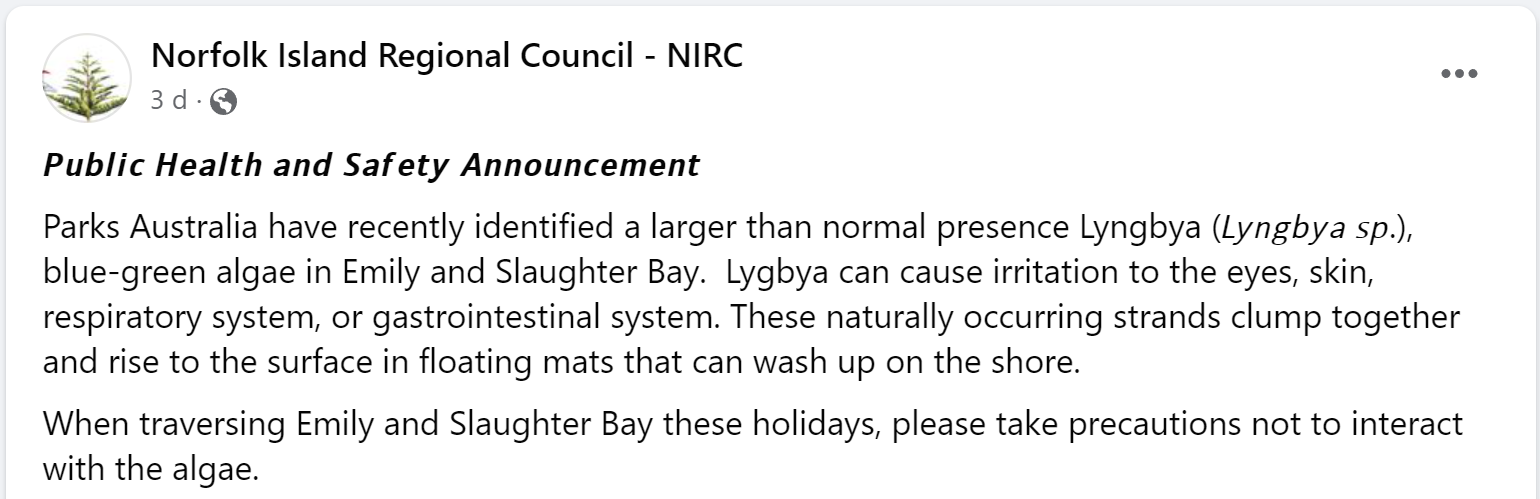
View fullsize Screenshot 2022-12-30 182035.png
View fullsize NIRC social media posts, December 2022
NIRC social media posts, December 2022
  • A year ago I reported on the increase of an algae known as Lyngbya majuscule and the furry little sea hares that feed on them. I wrote about this in the blog post ‘Furry Sea Hares as Eco-warriors’. Here we are a year later and Norfolk Island Regional Council, in association with Norfolk Island National Park, has had to issue warnings about not ‘interacting’ with this particularly nasty alga, because, yet again, it is proliferating in our bay (see social media posts, above).

  • During the warmer months at the beginning of 2022, we had several algal-bloom events in the water column in Emily Bay. In December 2022, we experienced the first one for this summer season. If you’ve never swum through one of these, imagine swimming through pea soup. It isn’t pleasant. And it is definitely not healthy for the reef.

  • In February and March 2022, we had another algae sweep across our corals. This time it was a thick choking red mat of cyanobacteria. To say this was heartbreaking is an understatement. I talk about this particular horror in a blogpost called ‘Come on in. The Water’s Fine’.

  • An alarming drop in sea cucumber and sea urchin numbers was noted by myself and other snorkellers, and by the team of reef researchers to the island. These animals are essential to a balanced ecosystem. If too many are removed, or if they fail to thrive, that is not good. You can see my two blog posts on these two critters here: ‘The Importance of Sea Urchins’ and ‘Heroes of the Beach – Sea Cucumbers’.

  • Then we had the heartbreaking case of Doris, the green sea turtle. Emaciated, covered in algae and clearly very weak, she was rescued by a group of us and has been in the care of volunteers and staff at the National Parks office since. Hopefully, 2023 will see her return, but to what? You can find out more about her story here ‘#OperationDoris Green Sea Turtle Rescue’, or search for the hashtag #operationdoris.

  • Sea squirts have been increasing across the lagoonal area. Is this relevant? Is it significant? I don’t know, but there are a lot of them encrusting corals where there were very few previously. I wrote about these here in ‘Sea Squirts – Friend or Foe’.

  • The researchers who give us the science about what is happening on our reef are quite clear and unequivocal in their assessment: In an article in the Sydney Morning Herald on 20 November 2022, Dr Trace Ainsworth says, ‘the rate of diseased coral in Norfolk Island’s lagoonal reef [i]s now among the highest recorded on an Australian reef.’ You can read more about what the experts say in ‘Norfolk Island’s Forgotten Reef Needs Help’.

Is there any good news?

Well, yes, there is. But it’s a bit like the proverbial curate’s egg. With the good also comes the bad. Professor Andrew Baird, chief investigator at the former ARC Centre of Excellence for Coral Reef Studies, estimates that at least 30 per cent of the coral species documented on Norfolk Island are undescribed, thus unknown to science. In other words, a third of our corals could be unique. The downside of that is that we could lose them before we even understand what we have.
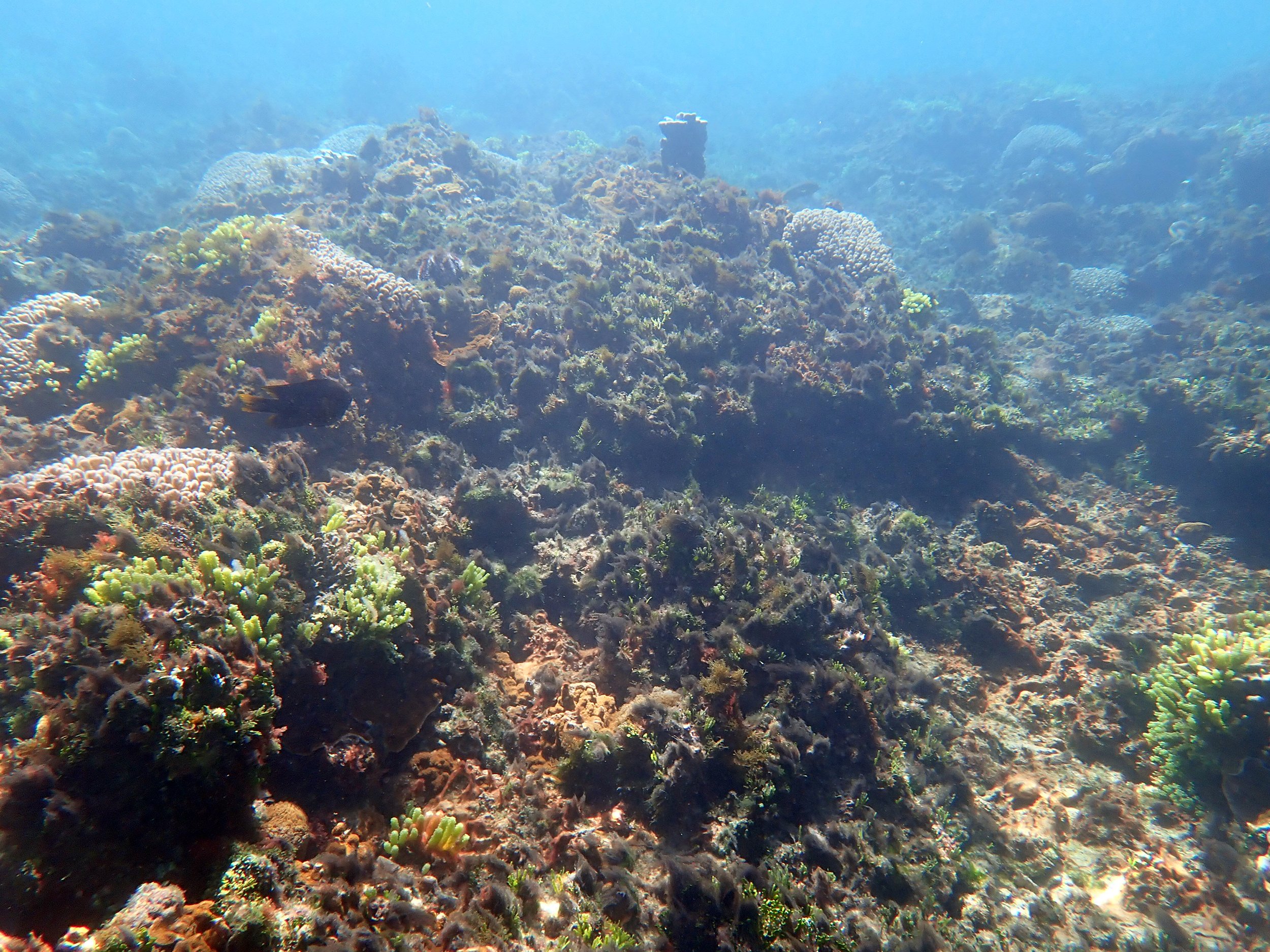
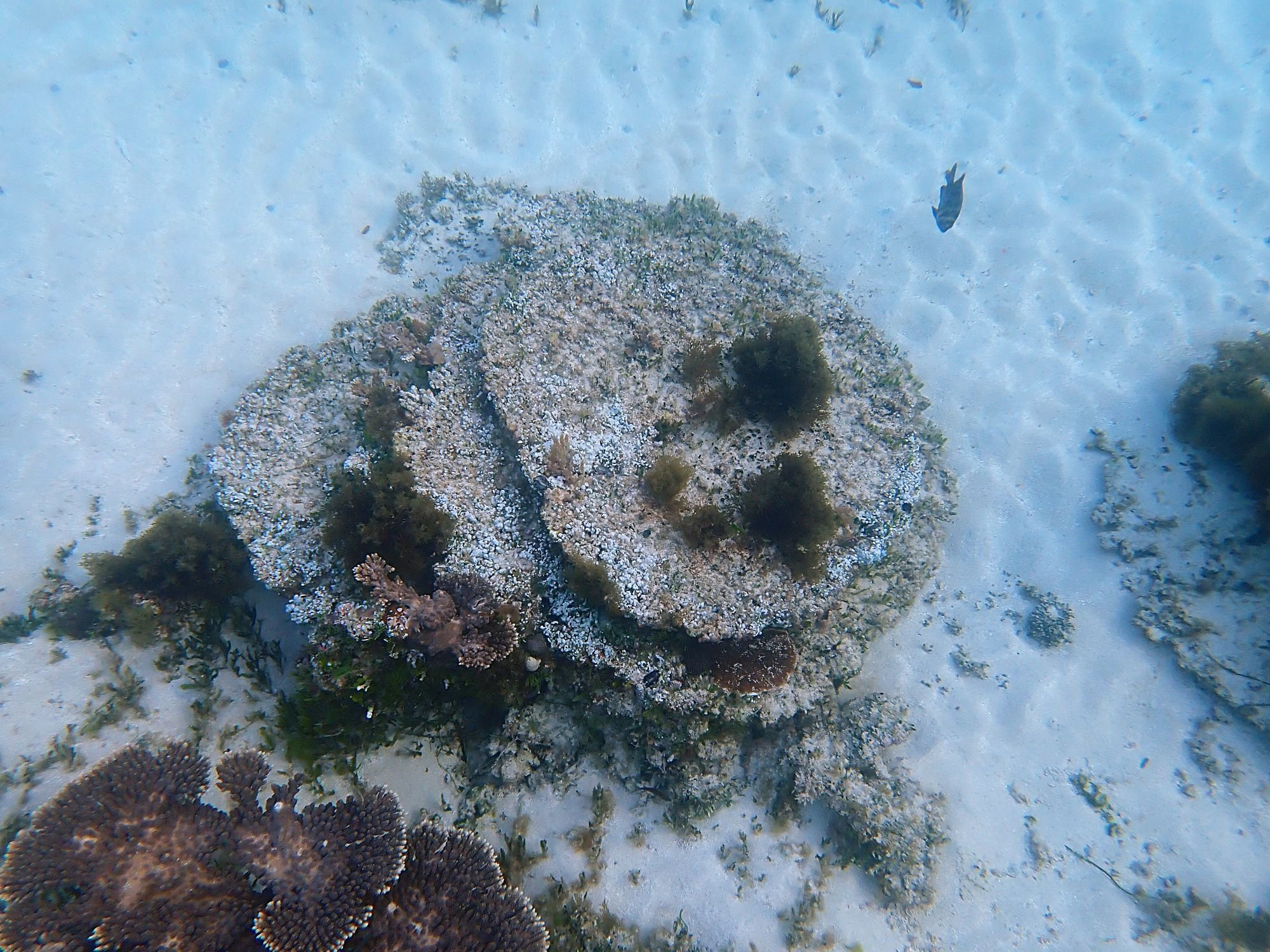
View fullsize Lyngbya majuscule on what was formerly coral reef
Lyngbya majuscule on what was formerly coral reef
View fullsize Algal bloom, Emily Bay, 20 March 2022
Algal bloom, Emily Bay, 20 March 2022
View fullsize Cyanobacterial mat pulled off the reef, 18 February 2022
Cyanobacterial mat pulled off the reef, 18 February 2022
View fullsize Tunicates growing on dead coral, 3 September 2022
Tunicates growing on dead coral, 3 September 2022
View fullsize Tunicates, 9 September 2022
Tunicates, 9 September 2022
View fullsize Doris, a green sea turtle, 10 September 2022
Doris, a green sea turtle, 10 September 2022

I have been raising the matter of our reef with politicians and the government for nearly three years now. In that time, the reef has deteriorated and some beautiful corals have succumbed to disease.

Those who frequent the bays are asking each other, where are all the fish? I am finding it increasingly hard to take decent photographs of some fish because they simply aren’t there anymore or are difficult to find. Here’s is a quick anecdotal assessment:

  • The bait balls (small juveniles or fry) have been missing in action inside the lagoons this year.

  • Beneath the raft, once a nursery for all kinds of species, is barren, partly due to Council’s new, improved design, but is there another reason?

  • The bluespine unicornfish have gone from four adults to one (plus one ‘teenager’ and a few babies).

  • The pencil surgeonfish have reduced from a small school of eight or nine individuals to two.

  • The catfish seem to be staying outside the reef more than they are inside.

  • The schools of mullet are much smaller.

  • The busily voracious schools of elegant wrasse are noticeably smaller, too.

  • The small family groups of three and four bluespotted cornetfish are reduced to one or, if you are lucky, two individuals inside the reef.

  • I last saw a Norfolk Island blenny (only found here on Norfolk Island) in April 2022.

  • I saw my first leopard flounder since March 2022 a week ago.

  • Yellowstriped goatfish, cardinal goatfish and blacksaddle goatfish? All reduced in numbers.

I could go on, but I won’t bore you.

Will I be writing in another year’s time that our reef has gone past the point of no return? I sincerely hope not. Let’s hope that 2023 is a much better year for Norfolk Island’s reef.

← Citizen science: your observations can be powerfulSunbeams and sunscreens →
Featured
From ridge to reef: unpicking the Waterway and Wetland Strategy
July 24, 2026
From ridge to reef: unpicking the Waterway and Wetland Strategy
July 24, 2026

Norfolk Island’s draft Waterway and Wetland Strategy will guide work for the next ten years. I support its intent, but it needs to be clear, practical and measurable – joining the dots from ridge to reef so we know whether public money is improving water quality and helping the reef.

July 24, 2026
Reef reality in pictures
July 13, 2026
Reef reality in pictures
July 13, 2026

Let the pictures do the talking. This is the reality on Norfolk Island’s reef today, laid out in a two-minute video.

July 13, 2026
The red seaweed behind low-methane beef
June 28, 2026
The red seaweed behind low-methane beef
June 28, 2026

A small red seaweed on Norfolk’s reef has become part of a much bigger story. Asparagopsis taxiformis can look like a delicate red feather duster or, at another stage of its life cycle, like a tiny cottony pom-pom. It is beautiful, easily overlooked, and now being used in the cattle industry to help reduce methane emissions. This post looks at the reef oddity behind the low-methane beef story – and why repeated local observation can be more useful than it first appears.

June 28, 2026
From coral scar to aatuti farm
June 20, 2026
From coral scar to aatuti farm
June 20, 2026

Aatuti are bold little algae farmers, but how does one of their farms begin? Over the past year, I have been following several coral patches as small white scars became algal footholds, then larger defended patches. I still cannot say what caused the first wounds, but the photo sequences show something fascinating: on a reef where algae is already gaining ground, even tiny changes on the coral surface can become part of a much bigger story.

June 20, 2026
Norfolk’s water quality – when action is reported as outcome
June 15, 2026
Norfolk’s water quality – when action is reported as outcome
June 15, 2026

A recent Australian Government media release presents investment, monitoring and catchment works as progress on Norfolk Island’s water quality. Some of that work is useful, and some of it was badly needed. But activity is not the same as proven improvement. This post looks at Kingston sewerage, wetlands, cattle, acid sulfate soils, groundwater and reef health, and asks whether Emily Bay and Slaughter Bay are actually being better protected.

June 15, 2026
How surgeonfishes got their name
June 14, 2026
How surgeonfishes got their name
June 14, 2026

Surgeonfish are named for the sharp little scalpels near their tails, but on Norfolk’s reef their more useful work happens at the other end. Pencil surgeonfish, bluespine unicornfish and their relatives help browse algae across the reef – a small daily job that becomes very valuable on an algae-rich lagoon reef like ours.

June 14, 2026
A shrimp storm
May 28, 2026
A shrimp storm
May 28, 2026

While setting my research cams last week, I swam into what looked like an underwater snowstorm. It appeared to be the aftermath of a mass moulting event, with large numbers of tiny, translucent shrimp-like exoskeletons drifting together near the surface.

May 28, 2026
Kingston dredging: what happens when a reef does not fit the framework
May 28, 2026
Kingston dredging: what happens when a reef does not fit the framework
May 28, 2026

This correspondence with DCCEEW is about more than one dredging proposal. It is about what happens when an ecologically distinctive place is assessed through standard tools that do not always make its most important values easy to see. I am publishing it here because that is something we need to be aware of, both on Norfolk Island and more broadly in Australia.

May 28, 2026
Kingston dredging: the project advances, the questions remain
May 24, 2026
Kingston dredging: the project advances, the questions remain
May 24, 2026

Kingston dredging is edging closer, and the paper trail is growing. This post brings together earlier correspondence with the Department and the latest media release so readers can see what has been asked, what has been answered, and what still remains unclear about the project, its rationale, and the protections proposed for the reef.

May 24, 2026
The lime-green coral in Slaughter Bay – a 40-year paper trail
May 17, 2026
The lime-green coral in Slaughter Bay – a 40-year paper trail
May 17, 2026

Green Mountain – the name I give this coral in my database – is a coral I’ve photographed for years as I swim past. Then I found its backstory in the Norfolk Island National Parks archives: a rough map, reused paper, a note in the margin – ‘still thriving’. That’s how baselines begin.

May 17, 2026

Latest Posts

© 2026 All rights reserved.